
As part of a growth company, the leadership’s focus is always on leveling up to the next stage: start-up to break-out, break-out to potential plateaus, plateaus to Merger and Acquisitions (M&A), and M&As to eventual exit.
But moving between these growth lifecycles demands one of the highest levels of adaptability and agility seen in the business world.
For private equity firms, venture capitalists, board members and executive teams alike, understanding where a company is in its lifecycle is not an academic exercise. It directly informs investment strategy, leadership composition, operating focus and the types of partners required to move the business forward.
All too often, growth companies fall into a pit of status quo and struggle to move up. They think what helped them win in one lifecycle stage will continue to be the secret to their future success. Misalignment threatens to stall, plateau or, even, undo growth.
In this series, we break down each of the six stages of growth company lifecycles and provide insights for your team’s success in each stage.
THE GROWTH COMPANY LIFECYCLE: 5 STAGES
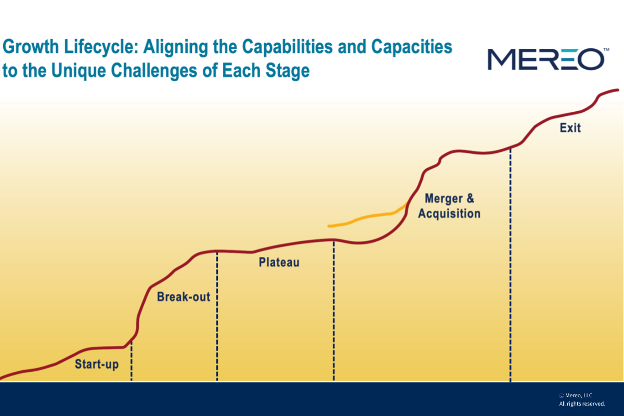
While no two companies follow the exact same path, most growth organizations experience some version of the following stages:
- Start-up
- Break-Out
- Plateau
- Merger & Acquisition
- Exit
Not every company will experience every stage. Some phases may last years — others may last a quarter. Some organizations bypass stages entirely through proactive strategy and execution.
What matters is recognizing the signals and aligning priorities accordingly.
STAGE 1: START-UP — SCALING THE IDEA
The start-up stage is defined by idea validation, not operational scale. At this point, the company typically has a solution that needs (aka “in search of”) a clearly defined problem.
The primary growth questions are foundational:
- What problem are we truly solving?
- Who has this problem and needs this solution?
- How big is the market opportunity, and is it large enough to justify investment?
- What is the value of the solution, and will buyers pay for it repeatedly?
From a go-to-market perspective, this stage is about learning, not efficiency. Messaging changes frequently. Value propositions are tested and refined across buyers, industries and use cases. Early customers often serve as “lighthouse” accounts — valuable for insight and credibility, not scale.
Investors at this stage are underwriting risk. Many founders want “hands-off” capital, but, in reality, they often benefit greatly from investors who can actively support gaps in experience, whether operational, commercial or strategic.
→ Priority focus: Proving the idea has value and a market worth pursuing.
STAGE 2: BREAK-OUT — SCALING THE GO-TO-MARKET MODEL
At break-out, the question is no longer “Does this work?” but “Can this work at scale?” Founder-led selling gives way to sales teams. Informal processes must become repeatable systems. And scrappy success must become documented and operationalized.
The primary growth questions include:
- What are the ideal channels / routes to market and how do we activate them?
- What is the compelling value proposition?
- How do we trigger market awareness?
- How do we navigate the sales motion with efficiency while minimizing risk?
This is where most organizations struggle — and even those that find success catch a market trend with favorable tailwinds, but the operational disciplines mute excellence. The solution may work for a select few clients, but it is not ready for broader scale nor is the organization architected for that scale. Unfortunately, too often teams continue operating as if they are still in start-up mode, customizing everything, chasing edge cases and relying on heroics rather than building repeatable growth engines.
Growth-oriented private equity often becomes more involved at this stage, bringing both capital and expectations around scalability, predictability and performance.
→ Priority focus: Scaling the operating and go-to-market model without losing momentum.
STAGE 3: PLATEAU — ADAPTING THE GO-TO-MARKET MODEL
Hitting a plateau in the growth lifecycle often emerges from incomplete break-out execution. Simply put, scale stalls. Perhaps there was imbalanced investments across sales, marketing and product. Maybe the organization failed to pivot to a changing market dynamic or there was an industry reality completely out of everyone’s control. This is a season of the lifecycle everyone wants to avoid, and, for some, it is a minor blip on the radar to extraordinary success. But for most it is a very trying time that tests every ounce of fortitude, leadership and savvy.
The primary growth questions hindering success are:
- How do we capitalize better on market trends to generate demand?
- How do we differentiate more effectively against competitive threats?
- What ways can we re-energize the team and the market?
- How do we identify and remediate the bottlenecks and friction in the model?
In recent years, broader market headwinds have made plateaus more visible and more common. However, market conditions usually expose underlying execution gaps rather than create them. For too many organizations, the plateau turns into a decline mode where restructuring is more critical than adaption.
Plateau is a transition state. For some companies it lasts briefly. For others, it marks the beginning of deeper decline if left unaddressed.
→ Priority focus: Diagnosing constraints and adapting the growth model.
STAGE 4: MERGER & ACQUISITION — INTEGRATING THE GO-TO-MARKET MODELS
M&A often follows a successful break-out phase and allows companies to accelerate scale, expand capabilities, enter new markets and strengthen competitive positioning — where acquisitive growth acts as a force multiplier to organic growth. For others, M&A is a more feasible model to scale than organic growth. However, M&A introduces new complexities, including ones that are, actually, magnifiers of previously unaddressed challenges.
The primary acquisitive-related growth questions are:
- What elements of the model need to be rationalized?
- What are the true “best practices” we need to standardize?
- How do we identify white space and activate cross-selling?
- How do we instill a common culture and set of operating principles?
Leadership teams at this stage are often selected specifically for M&A execution. Investors become more hands-on, prioritizing disciplined integration and a savviness for harmonizing what are often competing interests and cultures.
→ Priority focus: Repeating and integrating the growth model at greater scale.
STAGE 5: EXIT — VALUING THE GO-TO-MARKET MODEL
Exit is the culmination of the lifecycle, not the end of the story. Whether through acquisition, recapitalization, or public offering, effective exit readiness depends on predictable revenue performance, clear growth narratives, proven leadership and systems and clean operational execution.
The primary growth questions for value monetization are:
- What aspects of the model are creating friction / dragging down enterprise value?
- What levers can we employ to maximize the enterprise value / accelerate a strategic exit?
- What untapped market opportunities are accessible with additional capital / new ownership?
- Where is the value proposition more compelling?
At this stage, both investors and executives are aligned around monetizing the value created to its upmost. Many leadership teams are contracted explicitly to prepare the business for sale within a defined window.
→ Priority focus: Maximizing enterprise value and transferability.
WHY SERVICES AND PARTNERS CHANGE AT EACH STAGE
One of the most overlooked implications of lifecycle awareness is this: Each growth stage requires different external support.
As companies evolve, so do their needs for:
- Go-to-market strategy
- Sales and marketing alignment
- Market and product positioning
- Revenue operations
- Financial, technology and talent infrastructure
Sophisticated investors recognize this and proactively introduce partners who can address specific constraints at each phase. The goal is not generic support but stage-appropriate expertise.
This is where firms like Mereo play a critical role, helping leadership teams and investors align growth strategy, execution and outcomes to the realities of their current lifecycle stage.
Growth is not linear. But with lifecycle clarity, it can be intentional.