
Most leadership teams think about “exit” as something that happens later — when the bankers show up, the Confidential Information Memorandum (CIM) goes out, and due diligence begins. But by the time those conversations start, your ability to shape the story (and the valuation) has already narrowed.
Real leverage comes from exit readiness — with an emphasis on readiness. That means doing the work before an investor, private equity firm, or acquirer shows-up and points out what is broken.
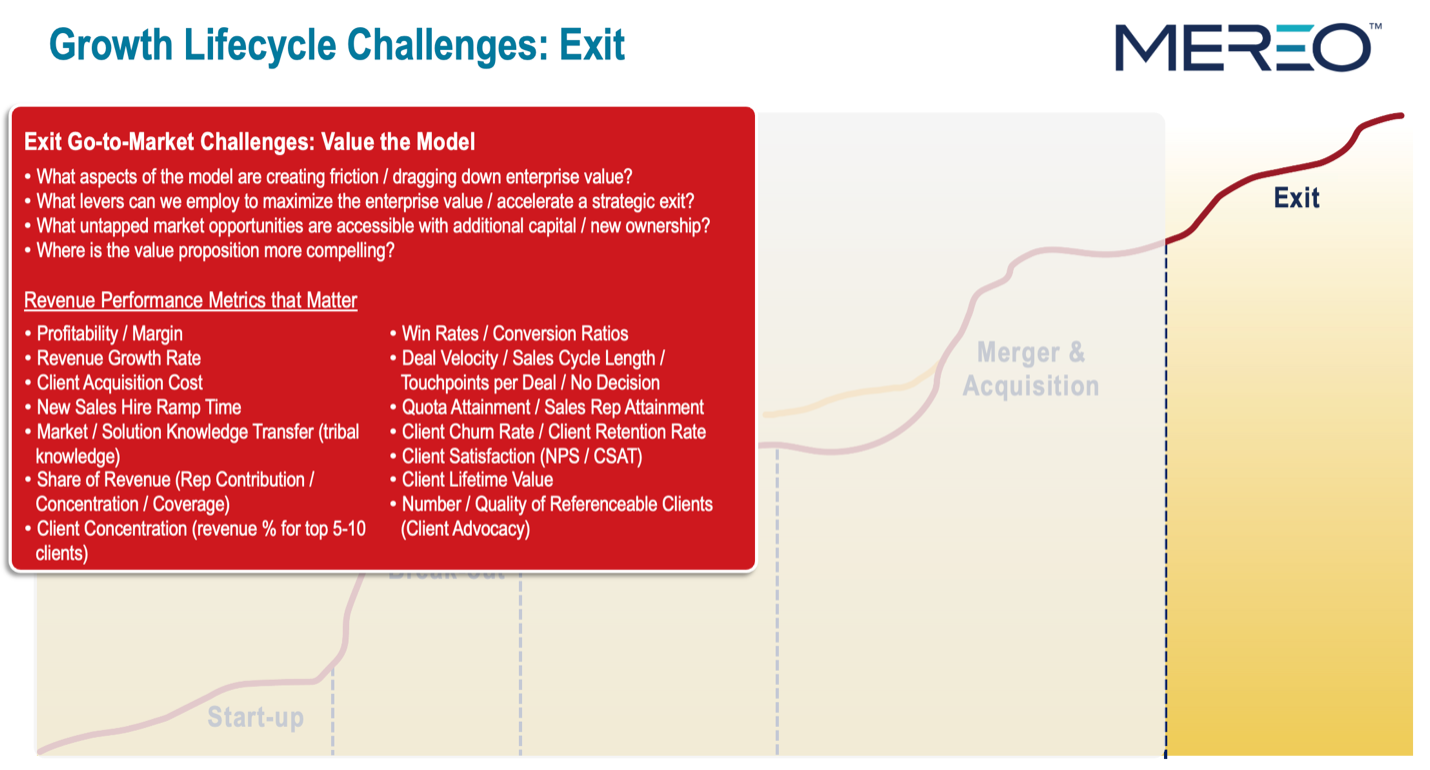
Below are the main ways you can be proactive, rather than reactive, in preparing your organization for an eventual exit.
1. START WITH AN HONEST SELF-ASSESSMENT
A buyer or investor wants to know: “If we add capital and more sellers, how reliably does this machine turn that into additional profitable revenue?” Proactive exit readiness lets you answer with confidence and evidence.
Key questions to ask:
- Sales process: Is your sales process documented, understood and used? Or does it live in the heads of a few “hero” sellers?
- Value proposition: Are your value propositions relevant and current? Do they reflect where your market (buying dynamic and competitive landscape) is today — not where it was three years ago?
- Voice of the customer: Where are you relying on opinions instead of customer-backed data? When was the last time you deliberately went out to collect fresh feedback?
- Sales kit: What decks, one-pagers, client value studies, ROI tools and playbooks exist? Where do they live? Are they centrally accessible? Do your current sellers employ them regularly?
- Deal velocity: How long does it take for your teams to move from opportunity creation to close?
Think of this like a “new leader” baseline. A new executive in the role would want to quickly understand the reality of the go‑to‑market motion. You want the same visibility now — before an investor performs that evaluation for you.
2. BRING IN AN OBJECTIVE THIRD PARTY
You cannot fully evaluate yourself from the inside. Internal teams are inherently biased toward their own programs and approaches, protective of their turf and their colleagues, and inclined to interpret data through the lens of their “how we have always done it” status quo.
That is why a third‑party assessment is so valuable. An external partner can:
- Ask the uncomfortable questions you may not ask yourself
- Cut through internal politics and history
- Provide a point of view investors and buyers will see as more credible
Your go-forward partner — be that a financial partner or acquirer — will conduct their own due diligence likely with their own third-party, so be proactive and conduct a version of one on yourself so you can address any value leaks and accentuate any value levers.
3. TRANSFORM YOUR FINDINGS INTO A CLEAR, PRIORITIZED ACTION PLAN
An assessment without action is just a report. The real value comes when you distill your findings into a focused number of high-impact priorities. Maybe your value proposition needs refreshing. Perhaps the sales kit demands retooling, or your leadership needs to streamline onboarding of new sales hires.
Identify five to seven key areas you can improve upon to prepare for exit. For each priority, determine if you can address the issue now or if you can start addressing the issue and be prepared to show the investors that the problem is being resolved. If you need more capital to resolve an issue, this proactive assessment will allow you to signal to investors that your leadership is disciplined, self-aware and investable – and you can frame these insights as a use-of-capital story.
That said, exit readiness does not mean revealing every flaw to everyone.
- For investors or PE firms, you can be more open about the assessment: “Here is what we found, what we have fixed, what is in motion and where your capital will go.” This level of candor demonstrates maturity and stewardship.
- For strategic mergers and acquisitions, you may share less detail on vulnerabilities, especially early on. But you still benefit from the internal work.

EXIT READINESS DEMANDS BEING PROACTIVE
A future exit whether investment, merger or acquisition — is not just a financial event. It is a reckoning with the quality and scalability of your commercial engine.
Being proactive about exit readiness means you understand your own strengths and weaknesses first. You tighten your sales and marketing foundation and improve the metrics that matter the most to investors.
You may not be able to control market timing. But you can control how ready you are when opportunity knocks.
- Are you ready for objective third-party support? Schedule a 30-minute call with one of our revenue experts.
- Optimize your sales force success with these 10 most-important revenue accelerators.