Author: Joel Reed

Top Sales Magazine

{Top Sales Magazine} The State of Revenue Performance and an Opportunity for B2B sellers


The performance of the top companies around the globe can be a telling sign of our current economic environment — and an insightful opportunity for where sellers can Seek to Serve™ their buyers.

In Mereo’s fifth annual revenue performance report of Fortune 500, Global 500 and Russell 2000 companies for the 2017/2018 fiscal years, we have uncovered results not seen since before the 2007/2008 recessionary period — signs of positive growth in top companies.

Albeit there was still a significant portion of companies that experienced declining revenue or sluggish growth, especially compared to their peers, many organizations’ fortunes have improved. And this improvement is likely due to the effects of tax legislation and the stronger GDP.

In comparison, the Mereo 2016/2017 Revenue Performance Report showed a trend of increasing profits yet decreasing revenue. But this year’s report tells us a new story.

In this past fiscal calendar year, just 21% of Fortune 500 companies experienced decreased revenue; a year ago that number was an unnerving 48%. While this marks significant improvement in the performance of revenue laggards, it is still somewhat shocking that one in five of these companies had declining revenue and another 9% grew at less than 2% year-over-year.

Mid-sized companies, as represented by the Russell 2000, for the first time in our review performed worse than their larger counterparts with 27% showing declining revenue and only 46% growing at more than 5%.

On the other end of the spectrum, for the first time since the 2007/2008 recession, more than 50% of the Fortune 500 companies (50.7%) had revenue growth of more than 5% — which is over twice the number of companies when compared to last year.

This leaves us with a corporate landscape defined by “haves” and “have nots” — with the haves creating a significant performance gap between themselves and their poorly performing counterparts.

Companies’ Strategies in 2019 and Beyond

In our current economic environment, companies continue to focus on driving down costs and improving productivity. By doing so they will work toward improving profitability as confirmed by the most recent quarterly earnings reports that showed S&P 500 results averaging over 3.3%.

On the positive side, in addition to having stronger growth overall, companies in Quarter 1 forecasted positive earnings revisions by over a 2-to-1 ratio (Seeking Alpha April 28 S&P Earnings Analysis Brian Gilmartin). This means companies are committing to their shareholders that they will see continued earnings growth by either improving revenue or lowering costs — or both.

Read more in the July 2019 Issue of Top Sales Magazine for B2B seller opportunities…


Read More

Airbus A380

How solution strategy and management could have saved the Airbus A380 — or saved it from itself years sooner


In February 2019, Airbus announced it would stop the production of its A380 jumbo jet by the end of 2021. This comes after just 10 years in production and with more than an estimated $16 billion invested in the development with no profit to show — and rather a hefty weigh on their company financials.

Business solutions fail all the time. What makes this particular case study fascinating is how much the failure stemmed from an ineffective solutions strategy starting in its initial input and process to the delivery, launch and ongoing governance, or lack thereof.

Make sure your seat belt is securely fastened as we dive into the Airbus A380 case study, and in event of emergency, scroll to the bottom of the page to learn more how Mereo can help. 

The Initial Airbus A380 Strategy Input and Process

More than 40 years ago, Boeing introduced the 747 jumbo jet to market. It had experienced success but by the early 2000s, Boeing had taken note of where the market was heading and started developing the 787, utilizing new technologies and fuel efficiencies, to serve its market.

Cue Airbus, and at the same time it either missed the mark about where the market was heading or its business strategy demanded that it must offer a competitive offering to Boeing, to prove Airbus could create a product just as good or better. Regardless of the reason, the Airbus A380 jumbo jet was put into motion — at least 10 years too late — pressing forward without a seek to serve mentality.

From the start, the foundation of the A380 was on rocky ground, with a misaligned business strategy and corporate structure, including co-CEOs in France and Germany who ended-up failing to work in collaboration on critical aspects of the production and software systems.

What could have saved Airbus at this point from this massively delayed, costly, short-lived jumbo jet solution would have been an initial business competency and market analysis validation as the solution strategy was being developed.

At Mereo, we ask companies to consider and answer eight internal inputs prior to committing to a project. Do all these inputs need to be positives? No. Some may be challenges that the company can realize from the start and work around with alternative solutions. For example, if a company can be honest with themselves about their lack of organizational competency, they can find a partner company who can help fill in the gaps, saving them time and money in the end, and creating a better solution all around.
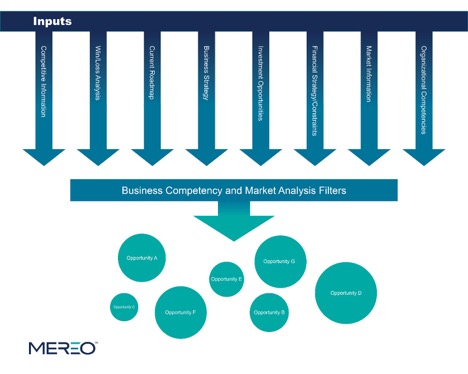
 

solution strategy


In the case of the Airbus A380, there were a number of inputs that were either ignored or that were overridden by the business strategy, including market information, organizational competencies and competitive information. Notably, Airbus had underestimated the complexity of the wiring and software centers, and engine and wing quality issues continued to delay the project, increase its costs and induce bad press.

The other aspect of the analysis that appeared faulty was external validation. Did Airbus look to its market to ensure the A380 would truly serve their needs? Emirates became a key customer, but Airbus traditionally serves the European market, and Lufthansa is the only European customer to purchase the jets, buying just 14 A380s. The A380 was quickly unappealing to many airports because the taxiway and gate infrastructure of the airport itself would need to be changed to accommodate this behemoth. Though passengers liked the spacious design and luggage handling, airlines worried about filling 500+ seats per flight.

This project seemed to have stemmed from a place of emotion and corporate pride to compete with a competitor who was already moving on to the next big thing, which ironically came in a smaller package. Was the Airbus A380 a technologically excellent achievement? Yes. But its market viability is dubious, and that can be further seen as we explore the ongoing delivery and execution.

The Ongoing Delivery and Execution of the Airbus A380

The Airbus A380 was many years late to market. Executives blamed the economic crisis and production issues for the late delivery in 2007. Yet it was more than this that was keeping Airbus from reaching its goals.

For a solution to be successful, there must be alignment across four plans within the organization: business, solution strategy, financial and go-to-market. Airbus was struggling across the board.

  1. Business: The overall business plan was failing in market growth, deliveries, performance and competitiveness.
  2. Financial: Performance was poor due to the cost overruns and poor revenue and delivery performance.
  3. Solution Strategy: This was missing the mark, was late, and competing internal strategies were already underway.
  4. Go-to-Market: The launch was late, there was under-delivery and a lack of input to ongoing strategy.

What could have saved them would have been a formal governance process, where they could have seen they were unable to check the necessary boxes and would have been able to stop, make significant changes to plans to improve market uptake or cut losses.

Yet either this governance process did not exist or the culture to step up and speak up about these clearly visible issues was unviable. And that lack of honest governance added-up to $16 billion in costs, well over their $6 billion goal.

By the time the Airbus A380 was going to market, they had already started developing a competing product, the A350, which was more in line with Boeing 787 fuel efficient, smaller jet with a focus on serving regional destinations without a need to feed a congested airline hub model. This regional service would prove more cost effective and would drive higher customer satisfaction.

The execution became the next area of failure. They did a big launch of the product. When you look at the launch, you have to ask if they executing on the launch plan (satisfaction, market uptake, on-time deliveries, production ramp, etc.)? And you come back to again what are the key metrics that define success and are we achieving those metrics? Airbus clearly was not. But no one pulled the plug in time to reallocate resources to the more important A350 project. 

All Solutions Face Issues At Multiple Junctures — What Matters Is How You Handle Those Challenges

The Aribus A380 should have never been green-lighted when it was. For your solution to be viable, it needs a market that would find it valuable. Your solution must be serving a buyer’s need.

Even if the market was ripe for the A380, the issues with the Airbus A380 solution management strategy are not unique. With this many moving parts and people, issues arise. In all cases, what is needed is a process and culture that can spot those issues, start data-driven questions and conversations, and react accordingly.

Airbus may have lost some money and some credibility if they pulled the plug on the A380 project midway through production. Yet, they could have stood by their decision with objective market, industry and financial facts to back it up. They could have put out their A350 better and sooner.

Because for every single minute you spend on one thing is a minute you cannot spend on something else. And if you spend those minutes on the wrong thing and don’t call it when it is clearly wasting resources, you will never be able to get those back.

Do Solution Management Right

At Mereo, we help companies align their business, validate their solutions and govern their processes to avoid failures like the short-lived, financial burden of the Airbus A380. Contact us to learn more.


 Solution Management



How B2B salespeople can engage buyers earlier in the sales cycle and provide additional value — in a context of business regulations


Business regulations and compliance requirements continue to expand across all geographies and industries. In the United States alone over the last 10 years, more than 30,000 new federal regulations have gone into effect — equating to more than 750,000 pages added to the Federal Register (Competitive Enterprise Institute).

Most recently and notably the General Data Protection Regulation (GDPR) went into effect in May 2018, impacting all businesses that process the data of European citizens, with non-compliance penalties of up to 4% of revenue. The European Parliament adopted a revised payment services directive (PSD2) in December 2015, promoting development and use of innovative online and mobile payments through open banking. Likewise all around the globe a small sampling of new regulations show this trend is accelerating and worldwide:

  • Australia implemented a New Payment Platform (NPP), affecting financial services.
  • The US Office of the Comptroller of the Currency (OCC) invited Fintech companies to apply for special national charters, providing a path towards becoming a bank.
  • In the US, the Health Information Trust Alliance, or HITRUST, in collaboration with healthcare, technology and information security leaders, has established a Common Security Framework (CSF) including a prescriptive set of controls that can be used by all organizations that create, access, store or exchange sensitive and/or regulated data.
  • Canada is in the process of reviewing the federal financial sector framework.
  • Hong Kong is upon a new era in smart banking.
  • India implemented the Unified Payments Interface (UPI).
  • Japan made amendments to its Banking Act in 2017.
  • Singapore developed the Finance-As-Service: API Playbook.
  • South Korea implemented a Fintech open platform.
  • The list goes on; it is pervasive and it is not slowing down soon.

In order to survive in this ever-changing and growing regulatory environment, business leaders and their IT partners must stay abreast of regulatory changes and drivers, as well as ensure they check all the compliance boxes — while at the same time proactively identifying and addressing vulnerabilities and responding quickly to even the slightest breach. Business leaders must be able to prove they have been compliant, they are compliant and they will be compliant through appropriate transaction recordkeeping, data lineage (traceability), monitoring and controlling processes, and informing audits — all while managing data, infrastructure and personnel costs effectively. The risk of failure to comply is nothing to scoff at: fines, penalties, brand devaluation, company and personal reputation and more pose the greatest risks. For instance, as of January 21, 2019, Google was penalized for 50 million euros by the French National Data Protection Commission (CNIL) in accordance with GDPR for infringing on essential principles of transparency, information and consent.

These business regulations may prove limiting for buyers — but they offer a unique situation for the B2B seller.

There is a substantial opportunity for informed sales teams to transform into informed business partners.

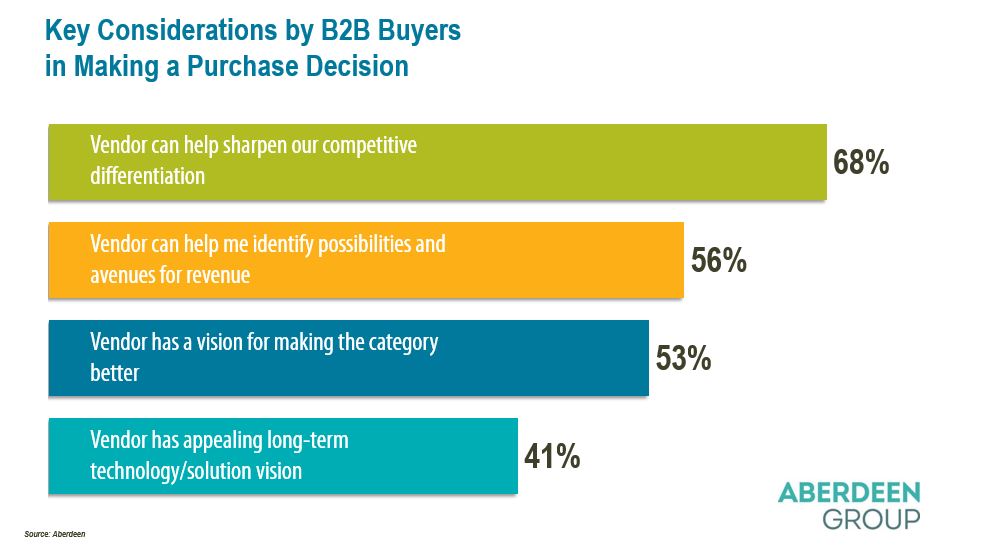
According to a recent study conducted by Aberdeen Group, B2B buyers seek out sellers who can sharpen their competitive advantage and have an appealing long-term technology/solution vision, among other things.


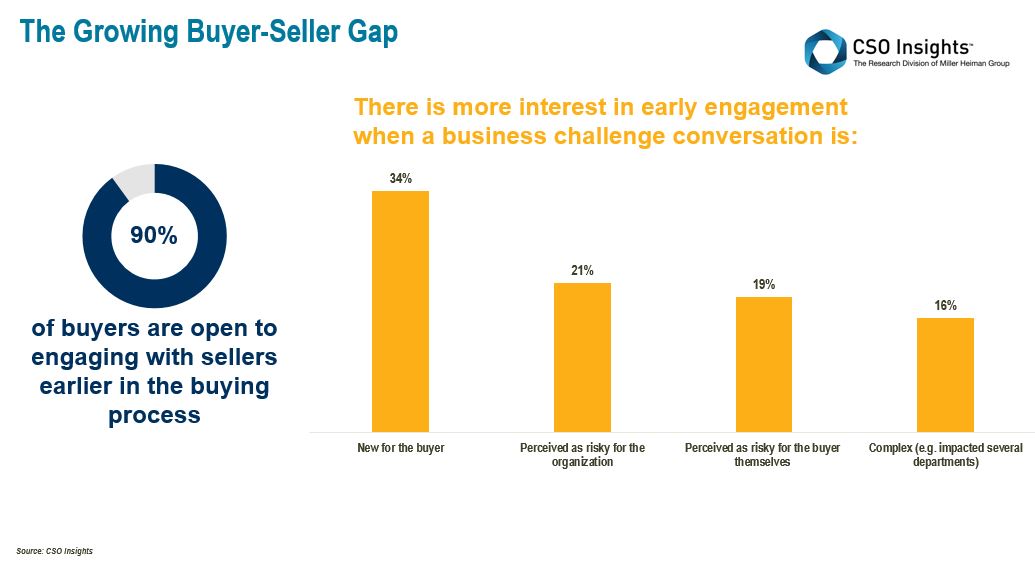
Yet, 30% of the time buyers are not engaging sellers until after they have identified and clarified their needs — and another 26% are not engaging with sellers until after they have identified a solution (CSO Insights).

There is a silver lining in these discouraging statements, however: 90% of buyers are willing to engage salespeople earlier in the buying process if the sales team is providing specific value (CSO Insights).


As such, with regulatory and compliance requirements growing in scope and complexity — compelling businesses to find solutions that enable them to comply with these regulations in a way that does not impede business strategy or break the bank — B2B sellers have an opportunity to position their value proposition in a unique business regulation framework.

Through this framework, sellers can become trusted partners to buyers.

In order to achieve this level of service, B2B sellers need to be viewed as knowledgeable and credible through the means of:

  • Educating sales teams around relevant regulations, with their business impact and solution value in the context of the regulatory environment.
  • Growing and maintaining a social media presence, sharing relevant thought leadership.
  • Providing solutions that are validated, certified and approved where applicable.
  • Attending trade shows and events with speakers who are at the forefront of relevant regulatory activities and compliance tools and processes.
  • Developing assets such as references, case studies and process demos that help the buyer better understand what the regulations mean to the business and the value of the solution in context of helping the business adhere to business regulations.
  • Engaging in sales conversations that put the client first — in a pain-solution-gain-proof framework.

For example, the VA at a location in Texas had outsourced its appointment mailers to a local printer unaware of the HIPPA regulations. The printer was mailing out patient and doctor details on postcards, which violated these regulations and could result in numerous fines, not to mention loss of credibility and trust with its patients. A well-informed seller stepped in, warning of the violation and providing its solution for compliance (sealed envelope). This seller instantly proved their value to the client and became a trusted source for their business.

Another company actually produced (in cooperation with their legal team) a summary of the new GDPR regulations with callouts to specific sections their solutions helped their customers address. This sales asset proved valuable to salesperson and prospect alike.

When salespeople are knowledgeable and credible in their buyers’ regulatory business environment, they will be able to engage buyers earlier with a higher level of interest, engage them in more meaningful conversations and position their solutions as serving these buyers’ needs in this environment.

If you are interested in discussing how your sales team can be better addressing your buyers’ regulatory needs, please contact us.


LEARN MORE STRATEGIES TO SEEK TO SERVE


2016/17 Revenue Study: The state of revenue performance and what that means for B2B sellers


Mereo recently completed its fourth annual revenue performance study of Fortune 500, Global 500 and Russell 2000 companies for the 2016 and 2017 fiscal years.

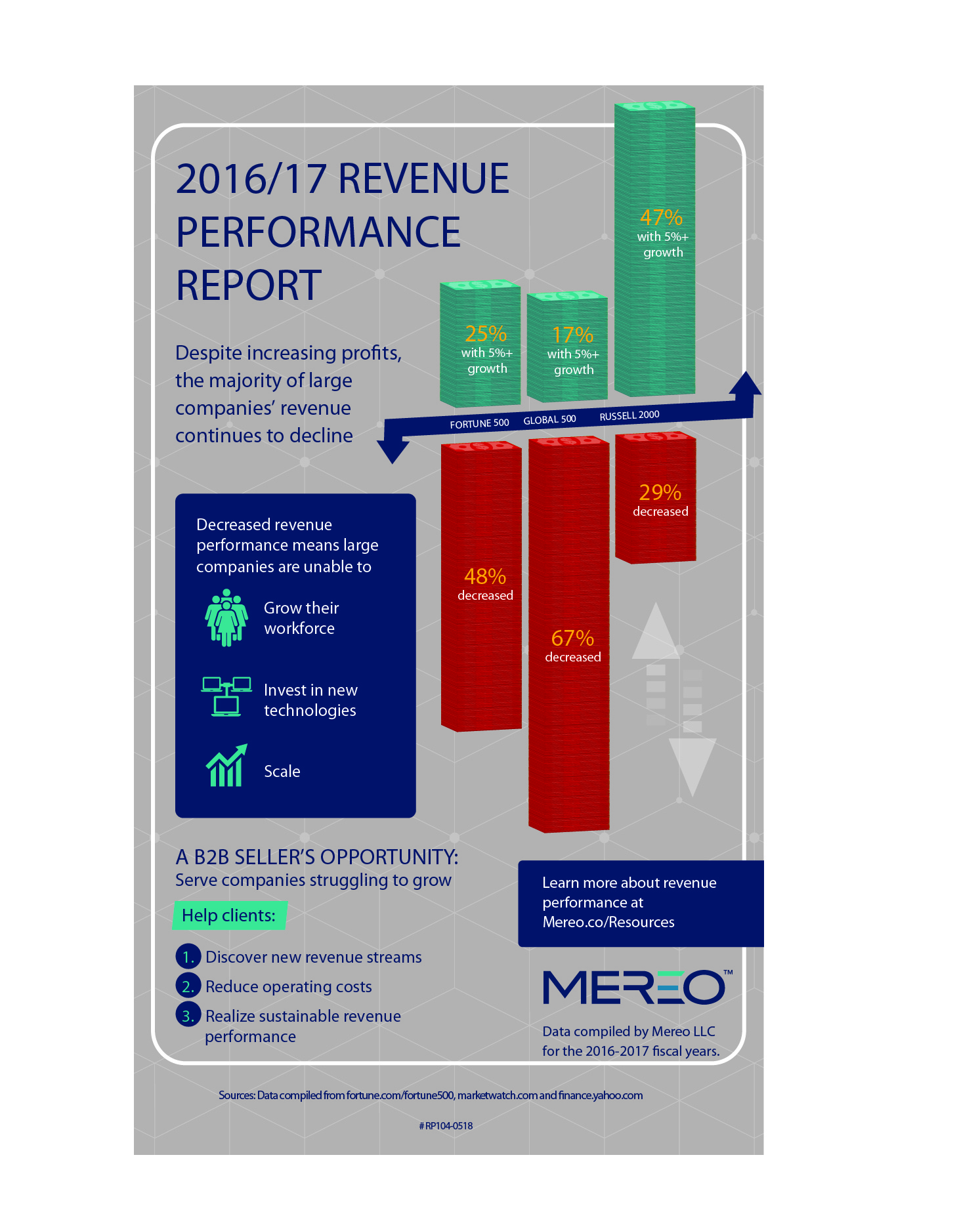
Once again, we have uncovered similar trends to previous studies — which has been consistent since the recessionary period of 2007 and 2008 — and we continue to be surprised by the underperformance of most companies’ revenue line.b2b sellersWhile there was some improvement as compared to last year, a relatively small percentage of companies can claim strong annual revenue performance. For instance, nearly 48% of Fortune 500 companies saw their revenue actually shrink last year (compared with 51% the year before) and nearly 67% of Global 500 companies reported declining revenue (as compared with 73% the year before). The somewhat brighter area was in mid-size companies, where a comparatively small 29% (still nearly 1 out of 3) of companies shrank this past year.

If we generously define strong growth as over 5% revenue growth, we found that only 17% of the Global 500 companies, 25% of Fortune 500 companies and 47% of mid-size companies met this hurdle in the past year.

So for the fourth year in a row, mid-size companies outperformed their larger counterparts and the Global 500 performed the worst.

What does this mean for B2B sellers?

A positive way companies can react to poor revenue performance is to continue to focus on driving down costs and improving productivity. By doing so they can continue to improve profitability as confirmed by the most recent quarterly earnings reports.

In this environment, sellers must focus their primary value statements around productivity and cost-reduction to resonate with their buyers. In addition, a seller can clearly show that they can help enable new revenue streams, as opposed to improving existing streams. They can also more easily engage the prospect around revenue growth benefits as well, since new streams of revenue are more easily quantified than increases in existing streams. If a seller has a solution that both reduces the costs and enables new revenue streams, they are in an excellent position in today’s market.

Initiating conversations with prospective buyers in terms of their current revenue and profitability environment, versus simply presenting your set of tools, will start to differentiate you from the competition in terms of how you sell in addition to what you sell. Demonstrating a knowledge of the current corporate environment and an empathy for the focus on cost, and helping the prospect uncover new potential revenue streams for their business, will position you as a valued partner focused on solving their problems versus a sales representative focused on your quota achievement.

While this data may seem dire, it does not have to be. Understanding the needs of buyers and seeking to serve them, right where they are, will set you apart in these interesting financial times. At Mereo, we thrive on equipping teams to provide value to their industry and serve their buyers. For guidance on how to have these conversations, contact us or give us a call at 512.400.0460.

Contact Us

Download our free eBook for tips on how to seek to serve your buyers today.

Download the Free eBook


How a sales training program put a company on a path to sustainable revenue performance within 6 weeks


When salespeople aren’t meeting quota, leadership can try to guess what is happening. They can place blame on a process or on the people on their team. They can chock it up to just a bad quarter or bad luck. But truly strong leadership will see the revenue performance shortcomings as an opportunity to learn and grow — and conquer revenue goals in the future.

The latter is exactly what Pitney Bowes leadership did when their sales weren’t meeting their goals.

The Sales Training Program

In February of 2017, Pitney Bowes engaged Mereo to take more than 300 of its salespeople through a training program. After a lot of deep diving into their company, talking with their clients and observing all the cogs and wheels moving — or not moving — from the outside, we devised a training program to reorient the sales conversation from solution-centric to client-centric. We designed a three-step program:

  1. Training the sales management team with an abridged program (no training program will stick unless leadership is engaged).
  2. Spending two days with salespeople (and with their leaders at the table for support) in intensive training leveraging BOTH real life and role-play situations based on actual client scenarios.
  3. Holding ongoing reinforcement sessions post-training with individual feedback.

We educated the salespeople and their leadership on techniques and tools to engage prospective and current clients in the context of their business workflows. Through understanding typical customer processes, typical challenges those processes can present to the goals of the company and opportunities to improve these processes, the salespeople started to see ways to better engage their clients.

At Mereo, we believe in seek to serve, not to sell™. This tenet led us to develop training that helps salespeople think about the business processes of the customer and to stop thinking about the product or solution first. This allows for new, engaging conversations between the salesperson and the buyer.

The Results

Within six weeks of the training program, Pitney Bowes achieved 137% quota attainment, a 37% growth in their sales pipeline, and an increase in deal size and appointment setting success approaching 80%.

What Does This Mean For You?

If your salespeople aren’t meeting quota — or you’re eager to put your business on a path to sustainable revenue growth — consider investing in one of your greatest assets: your people. It doesn’t stop there, either. In order for any new concepts to take root, leadership must be 100% invested, and that means taking the training alongside your salespeople.

Learn More About Sales Enablement

business strategies

How many business strategies does it take to grow a company?


Most enterprises talk about their business strategy as a singular entity with a singular focus. Yet, in reality four distinct strategies — all interdependent of one another — work together to help a business align its goals and efforts across departments and maximize opportunities for growth.

1) The Corporate or Business Strategy

The overall corporate or business strategy lays the foundation for the purpose of the business and the value it wishes to deliver to market — and more specifically to its target customers.

When developing your corporate or business strategy, evaluate your business and its purpose. Frame your defining questions in a way such as:

  • Is our business building mouse traps or are we exterminators?
  • Are we a mapping service or are we a service leveraging GPS to support all activities around movement?  

2) The Financial Strategy

The financial strategy designates a business’ financial metrics for success over a period of time and defines the types of revenue, cash flow and margins expected. The financial strategy must align with other strategies to reach its goals.

When developing your strategy, expect to discuss areas such as:

  • Do we sell products or services?
  • Are we transactional or relationship-driven?
  • Do we innovate or optimize?

3) The Solution Strategy

The solution strategy details whom a business is targeting, with what solutions and in what markets, and how the business will compete. This strategy lays the framework for what solutions will be developed, how these solutions will be created — organically, through a partnership or with an acquisition — as well as when the solutions will reach the market.

The solution strategy must:

  • Align to the corporate strategy (or work to inform the corporate strategy)
  • Support the financial strategy
  • Create context for the go-to-market strategy and be informed by the go-to-market strategy

4) The Go-to-Market Strategy

The go-to-market strategy focuses on the successful execution of the previous three strategies. Leaders can most easily set a barometer by which success can be measured here, and they can inform their solution and financial strategies while executing within their parameters and reinforcing the corporate strategy — in effect, creating the brand.

Your go-to-market strategy will incorporate the capabilities of the customer-facing organizations across all channels, including:

  • Sales
  • Marketing
  • Support
  • Services

Each of the four strategies should be revisited annually, if not more often, and they should be utilized as a filter and validation for one another on an ongoing basis. Misalignment of any of these strategies can lead to missed expectations; reduced return on investments in solution and go-to-market initiatives; confused and frustrated employees, customers and partners; and slow growth or entrenchment. But when aligned, your business will experience synergies and clarity across the organization — and within the market — and will realize corporate growth and success.

 
Does your team need help creating or reviewing one of these strategies? Do you need an outside eye to review how your strategies align across your organization? Contact us today for further information.


Product versus solution management — and why it matters


Enterprise executives often focus on the effectiveness of the product management process within a business and lament the inefficient use of resources or lack of sufficient return-on-investment (ROI) for research and development. The premise of the conversation is in itself representative of the underlying problem —product” is too narrow a focus and often inhibits understanding the real opportunity, which is to focus on offering a solution to the market. Solution management is different from product management in that its inherent focus is broader and that its processes engage a wider audience.

Product management focuses on the attributes, roadmap and pricing of a specific product.

Solution management focuses more broadly on solving a problem including the product itself, its delivery, packaging, service and support, and how it interacts with other solutions.

Example: Kayaking

    • Product: Kayak
    • Solution: Kayak, kayak accessories including seats, netting, helmets, paddles, life vests, transportation, kayaking how-to videos, etc.

Solution Management Captures a Bigger Picture

The solution management focus is on the product or service and its packaging, pricing, delivery, support, service, as well as how it interacts and any synergies to other solutions within the company or marketplace. This holistic approach often forces conversations on design, packaging and approach that will not or do not occur when focused on solely the product. The benefits of solution management are often higher order, such as market adoption rates, more satisfied customers, and better internal readiness and alignment.

Tip: What teams/functions are engaged in the definition, creation and launch of your company’s solutions? Are all the functions engaged from strategy definition to roadmap creation and through launch? Usually the easiest way to shift the focus from product to solution is to engage a wider array of business functions in these processes.

Solution Management Engages a Wider Audience

The solution management focus begins with an understanding of four key strategies within the business: business, financial, go-to-market and solution. Each of these strategies are critical filters for solution management activities and are validation checkpoints through all solution management processes. As a result, the organizations involved in these strategies have a seat at the table for solution management activities, typically including:

  •    Product Management
  •    Finance
  •    Development / R&D
  •    Marketing
  •    Sales
  •    Service/Support

The interaction of these functions ensures the outcome of solution management processes is in alignment with key strategies, broad and encompassing of all the components of a solution, and supported by the company.

Tip: Creating formality in key process steps will drive cross functional engagement. For example, the formal approval of a 18- to 36-month solution strategy document by executives representing key functions (product, sales, marketing, finance, service/support) as well as approval of each solution roadmap will drive cross-functional alignment and improved execution.

Solution management can lead to the achievement of higher returns on investment due to the identification of better solutions aligned to market needs, increased cross-functional engagement, enhanced execution of integrated launch plans and improved acceptance by the market.


Are you ready to take your solution management discipline to the next level? Learn how you can elevate revenue performance with expert solution management best practices in this exclusive Mereo eBook.


Disappointing business growth since recession


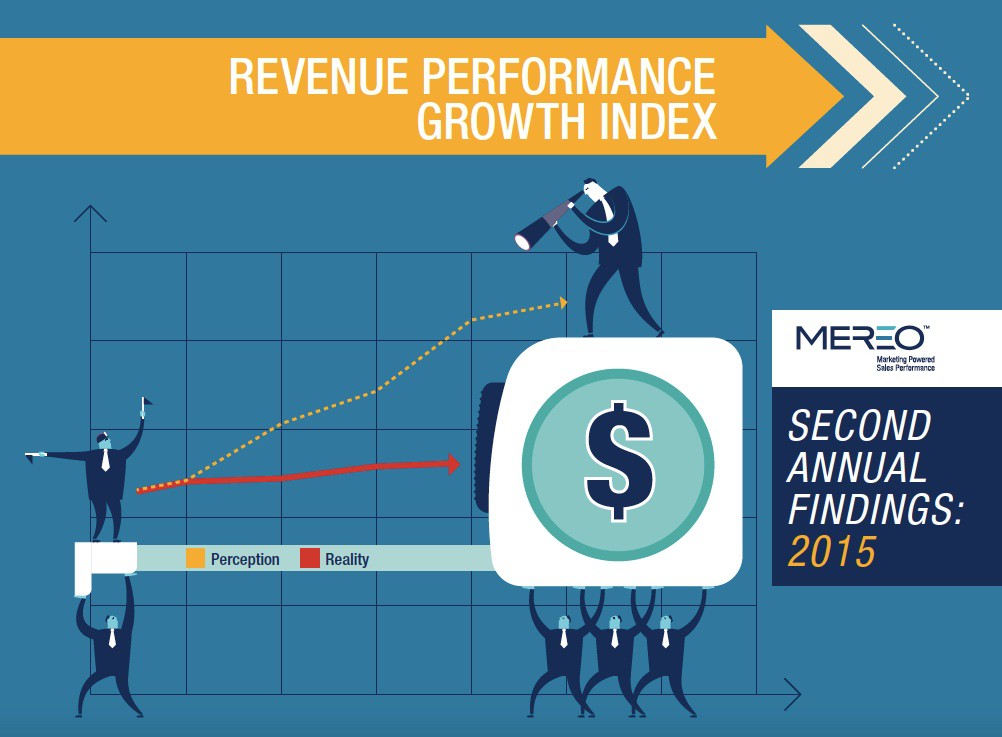
The recently released 2nd annual Revenue Performance Growth Index Annual Report for 2015 once again shows what can only be viewed as disappointing revenue results for both large and mid-size US public corporations, as well as the largest international firms. A quick snapshot of the report reveals some disturbing results and trends:

  • 29% of Fortune 500 companies had negative revenue growth this past year, and 40% grew at a less than 2% rate
  • 28% of the Russell 2000 companies had declining revenue, while 42% grew at a rate less than 2%
  • 36% of the Fortune Global 500 companies had negative growth over the past 3 years with 66% averaging less than 2% growth

Finally, and perhaps most alarmingly, over the past 6 years (since the bottom of the “Great Recession”) 1 in 5 companies are smaller now than in 2008, and another 10% grew at less than 2% coming out of this deep recession.

Read full report.

What is a sales person or sales manager to do in light of these results, and how does a marketing organization best arm sales for success in an environment that could well be described as hostile?

Let’s start with what these results mean, in general, for the organizations studied. These results likely translate into financial officers driving a focus within the organizations on cost and expense control and on productivity improvement. With little evidence that the go-to-market organizations can or will yield positive results, the internal focus is to cut, cut, cut and cut some more. Driving revenue growth is imperative, and programs to support that should gain traction. Yet the natural bent for executive leadership to deliver earnings growth is on expense control, while revenue programs will need to prove their value and show a track record of success to gain broader support.

As a sales person or manager selling to these companies in this business environment do not despair, especially if your solutions/products can demonstrate an ability to reduce costs or improve productivity. But, be aware that the buyers of a solution, your buyers, may be more skeptical than normal. This puts a premium on ensuring you and your team take the time to fully understand the prospect’s business and financial environment through advance research and in-depth discovery. And do not forget that your buyers’ personal success (e.g. salary, bonus, other compensation and maybe even career) may well be dependent on showing success in controlling costs and other expense-based metrics.

You also need to position your solution in terms of the ROI it will drive with specific proof points based on actual results, industry standards and always-critical customer success stories and references. In a difficult selling environment, references are even more critical as proof points – especially those in the same industry with similar problems and with buyers in similar positions.

If your solution can support revenue growth, your prospect’s recent history – and that of the industry at large – may create an environment of even greater skepticism. This may entail an even greater need to speak to specific pain points and issues that have been preventing growth. Further, it will likely mean you will need to be more prepared with well-grounded data, statistics and market information that support your position AND provide needed insights for your prospect. Finally, be prepared to demonstrate specifically how your solution solves the identified pain points including “day in the life of…” scenarios and prove your differentiated value proposition in context of your buyers’ environment with client value stories and strong references.

Companies can and do win in this environment. Let’s rephrase the previous statement for emphasis – Not only can you be successful, but you can be wildly successful in an economic climate such as this. Moreover, you can rise above the crowd and differentiate yourself for times when the headwinds are not so strong. Those organizations and professionals delivering breakthrough revenue performance focus on the sales team’s ability to properly prepare, discover and articulate key pain points, and position their solution to uniquely solve those specific issues. In addition, specific ROI benefits and supporting proof and references are critical to gaining approval of funds as your buyers seek to justify the investment. Marketing can support sales by fully vetting existing clients, developing reference customer engagement and nurturing processes and programs. They can also publish detailed customer value studies, as well as other sales ready assets, to support ROI and revenue growth capabilities. Ensure those tools in the sales kit are oriented around your target buying audience’s situation and reinforce the compelling value proposition your solution delivers.

Check out the full report to see the declining trends mentioned above HERE, and let us know how we can help your team win in this economic climate.

information@mereo.co

303.495.5200


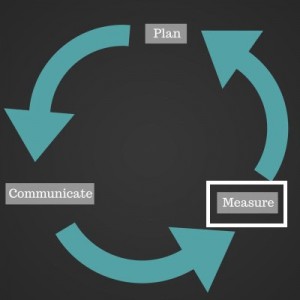
Effective launch: Measuring is key


Measuring actual results against expectations is one of the most critical launch focus areas and also the one that is often overlooked.  This is primarily the result of the perception of a launch as an event versus a process.

The type of measurement and monitoring required changes as the phases progress through the launch process.  Initially the team is measuring activities against the plan and spending against the budget.  The focus of these measurements are to ensure timelines are met, assets and deliverables are ready and budgets are not exceeded.

Once execution is underway the focus continues to be on activity and budget management but expands to also include results.  For Promotional and Market Impact launches key performance indicators tend to fall in 3 categories:

  1. Target Market Awareness
    • Internal Enablement– capability of sales and services/support often measured by engagement metrics and time to closure metrics
    • External Awareness – media and market awareness both aided and unaided as well as social media volume and type of exposure (positive and negative)
  2. Pipeline Development 
    • The volume and value of sales opportunities, supported by early stage lead development through social media, web and online shopping site interest/hits
  3. Revenue/Bookings Growth 
    • Actual sales of the product or service in question over a 3-12 month period as compared to previous sales and expected results

Finally, measurement and monitoring should include analysis of the launch process, the launch team and the launch results themselves to inform and improve the overall process and any other launches underway.  This can be accomplished via the regular Monitoring phase meetings as well as through surveys of the launch team and affected groups to understand what worked well and what could be improved.

As you hopefully now can see, effective launches are involved processes that engage a cross functional internal team and numerous external audiences.  With companies spending 5%, 10%, 15% or more of their revenue on product and service development why would they not ensure the PlanningCommunication and Measurement of the launch of the output of this investment is done every bit as well.

How has this process overview resonated with you? What impact will this have in your next product launch? Drop us a note about the changes you are implementing. And if you need a sounding board or some assistance for your next launch, let us know how we can help.

About Mereo

For organizations seeking to instill the go-to-market tenets paramount to winning an unfair share™ of sales cycles, Mereo powers sustainable revenue performance. Market leaders such as Ariba, Pitney Bowes, Accel-KKR, Appirio, SAP, Ace Hardware, Bazaarvoice, E2open, Microsoft, Symphony Technology Group, North Plains, OKI Data, CenturyLink, Oracle, The Vintage Racing League and dozens more employ Mereo’s revenue performance programs to unleash repeatable revenue growth. For more information about Mereo, visit the Firm’s website at www.mereo.co.

Media Contact
information@mereo.co
303.495.5200


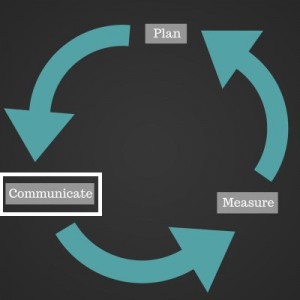
Effective launch: How to communicate


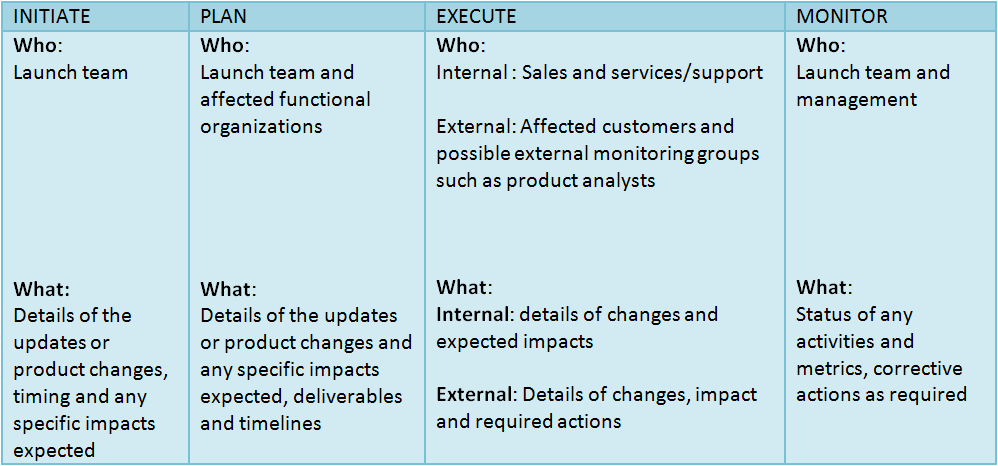
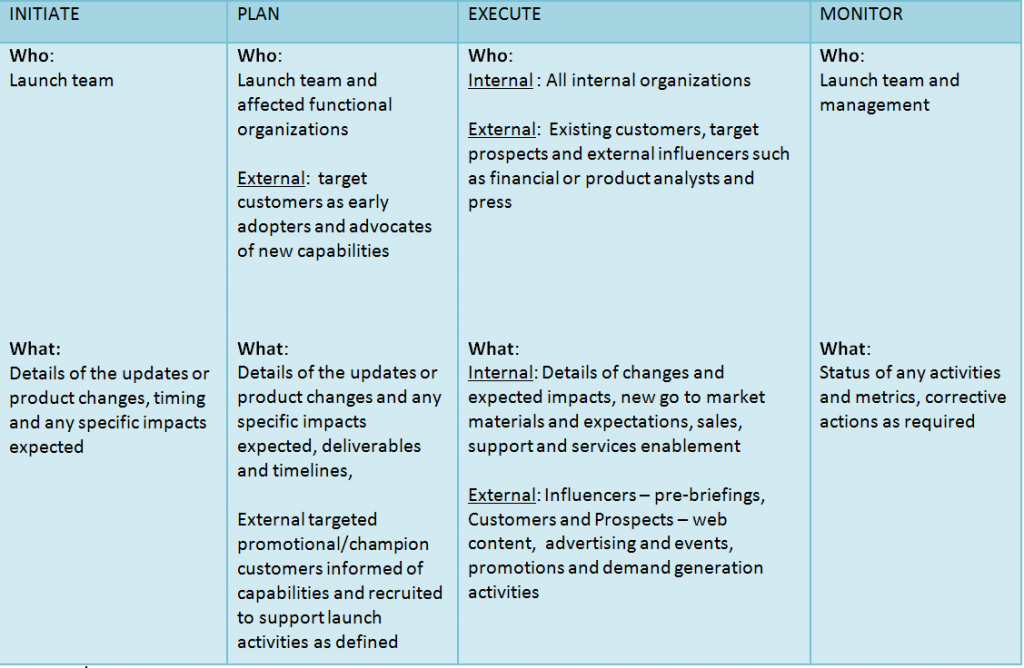
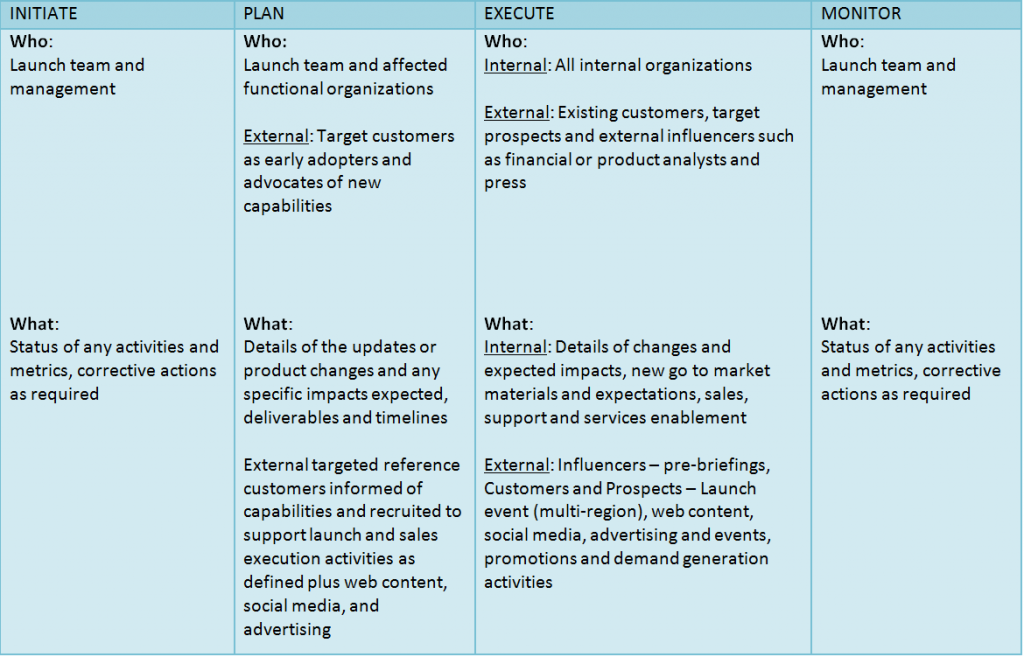
Communication in the context of a launch is about identifying what to communicate, when and to whom. The focus of communication will change by launch type and phase.  Internal communication to gain alignment and set priorities on execution is critical for program success.  External communication activities will vary by stage and audience.

Please see the following tables for some examples of how the focus of communication changes by launch type and phase.

Launch Category:

PRODUCT OR SERVICE UPDATE

Launch Category:

PROMOTIONAL

Launch Category:

MARKET IMPACT

Note that there are no differences in the Initiate and Monitor phases across launch types.  The key differences around communication occur in the planning and Execution phases as a result of increasing scope and budgets to enable the revenue goals via advertising, demand generation and sales execution support. In addition, as the launch category progresses and becomes more impactful to the company, the depth and breadth of communication and the number of associated assets, budget allocated and resources deployed will grow.

Now we’ve gone through planning and communicating, and next week we’ll conclude the Effective Launch with discussing how to effectively measure.